Direct and Indirect Earnings — Not Every Kind of Income Appears in a Bank Account
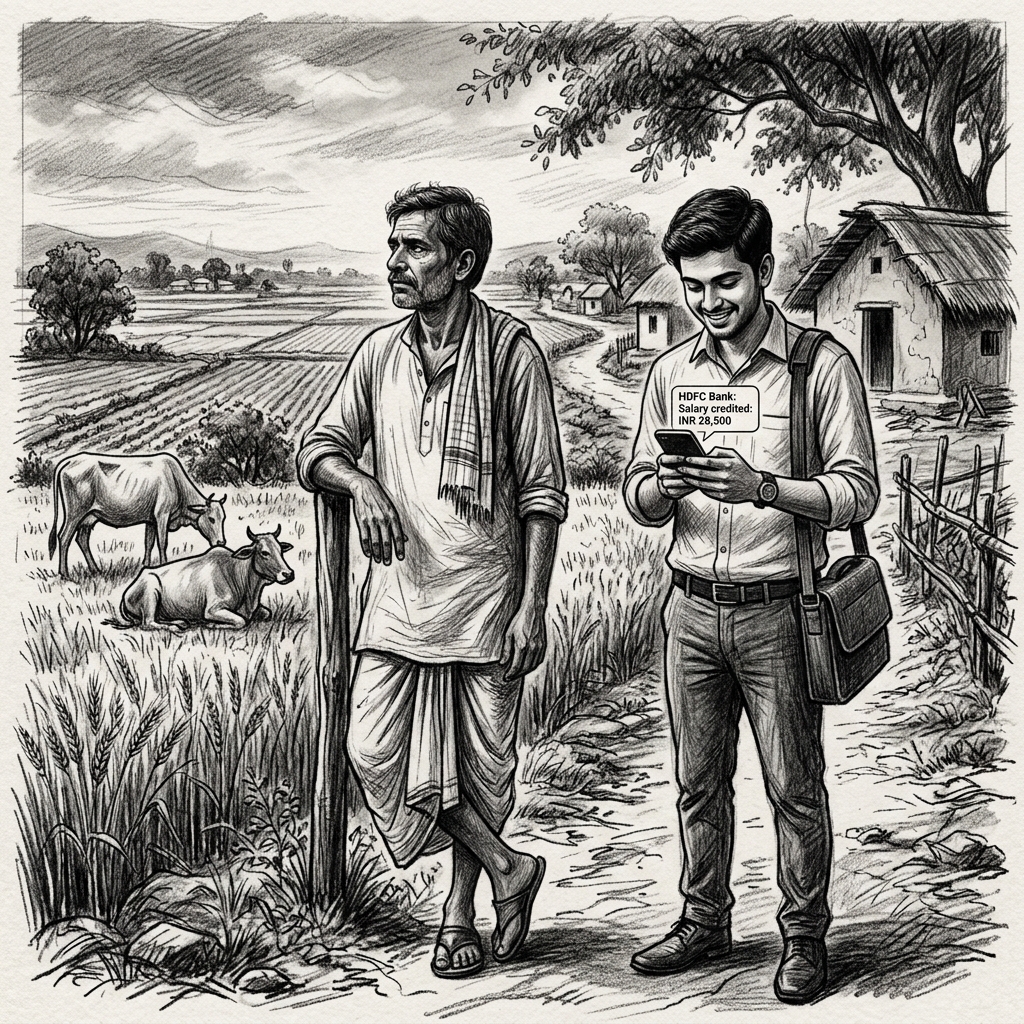
Not every kind of income appears in a bank account
Two brothers lived in a small village.
The elder brother stayed in the village.
He lived with their parents, worked on the family farm, and took care of the cows.
The younger brother worked in the city.
He had a fixed salary.
₹40,000 a month.
On the first of every month, the money would arrive in his bank account.
He would manage his expenses, send some money home, and try to save the rest.
Meanwhile, the elder brother woke up early every morning.
He fed the cows.
Collected the milk.
Went to the fields.
Checked the crops.
Arranged fertilizer when needed and managed the water.
He bought medicine for their parents and handled the small and big responsibilities around the house.
But if someone asked him—
“How much do you earn?”
He didn't really have an answer.
There was no fixed salary.
No payslip.
No fixed amount entering his bank account every month.
And perhaps because of that, he sometimes felt that his younger brother was earning more than him.
One day, the two brothers were sitting outside their house.
The younger brother checked his phone.
₹40,000 credited.
The elder brother smiled.
“Your salary came?”
“Yes.”
“That's good.”
After a while, the younger brother said—
“Brother, you should also move to the city. You could earn much more.”
The elder brother stayed quiet.
He knew his brother wasn't wrong.
But one question remained in his mind—
“If I also leave for the city, who will take care of everything here?”
The cows?
The farm?
Our parents?
The house?
None of these came with a salary.
But all of them needed someone every single day.
A few days later, the younger brother came home to the village.
One morning, he woke up late.
By then, his elder brother had already finished a lot of work.
The cows had been fed.
The milk had been collected.
Their mother's medicine had been brought.
And the work in the fields had already started.
That afternoon, the younger brother went to the fields with his elder brother.
There he realized that his brother wasn't simply farming.
He was watching the weather.
Managing the water.
Calculating the crop expenses.
Thinking about seeds and fertilizer.
And at the same time, taking care of the family.
On their way back, the younger brother asked—
“Brother, do you really do all of this every day?”
His brother laughed.
“What else would I do?”
That night, the younger brother kept thinking.
For the first time, he tried to calculate his brother's earnings.
The money from the milk.
The income from farming.
The vegetables grown at home.
The grain they didn't have to buy.
Taking care of their parents.
Taking care of the cows.
All the small and big responsibilities around the house.
If all of these things were given a market value, the amount wouldn't be small.
The only difference was—
none of it came with a payslip.
The next day, the younger brother sat with his elder brother.
He said—
“Until yesterday, I thought I was the only one earning.”
The elder brother laughed.
“And I thought you were earning more than me.”
They sat quietly for a while.
Then the younger brother said—
“Maybe we were both looking at our earnings the wrong way.”
His brother looked at him.
“I send money home every month.”
“And you take care of the home every day.”
“My earnings are visible in my bank account.”
“Yours are visible in the life of this family.”
That day, both brothers understood something for the first time—
earning isn't only what appears in your bank account.
We often measure income through salary, profit, or bank balance.
How much does someone earn?
How much does their business make?
How much do they have in savings?
But there are forms of earning that don't come with a salary account.
Taking care of your parents.
Growing your own food.
Taking care of animals.
Managing a household.
Giving someone your time.
Standing beside someone when they are struggling.
All of these create value.
We simply don't see their value directly as money.
This is indirect earning.
And the money we receive directly through a salary, business, or paid work—
that is direct earning.
They are different.
But both have value.
The younger brother earned ₹40,000 a month in the city.
That was his direct earning.
The elder brother didn't receive a fixed monthly salary in the village.
But every day, he was creating value for the family.
That was his indirect earning.
One brother was sending money home.
The other was taking care of the home.
One person's earnings were visible in the bank.
The other's were visible in the life of the family.
Maybe that's why we shouldn't measure a person's contribution only by their salary.
Because—
not every kind of earning is visible as money.
Some earnings enter your bank account.
Some earnings keep your home running.
One kind of earning is counted. The other is felt.
And sometimes, both are equally important.